Launch without the guesswork: a practical GTM checklist for builders
Go to market strategy checklist: You’ve built something you’re proud of — the kind of product you wish existed when you started. But launching it? That’s a different game entirely.
When you launch something you care about, the tough part isn’t building — it’s getting the right people to actually notice, try, and keep using it. That’s what this checklist solves: a compact, no-BS go-to-market plan you can run even if you have zero marketing budget.
Below you’ll find a phased checklist (Pre-Launch → Launch → Post-Launch), decision rules for choosing channels, one short example you can copy, and clear places to drop evidence (screenshots, numbers) so your post signals real value to both users and search engines.
Table of contents
- Phase 1 — Pre-launch: foundations
- Phase 2 — Launch: execution plan
- Phase 3 — Post-launch: momentum & growth
- Quick micro-case: what to copy
- Common pitfalls (and how to dodge them)
- Conclusion + subtle launch CTA
- FAQ (schema-ready)
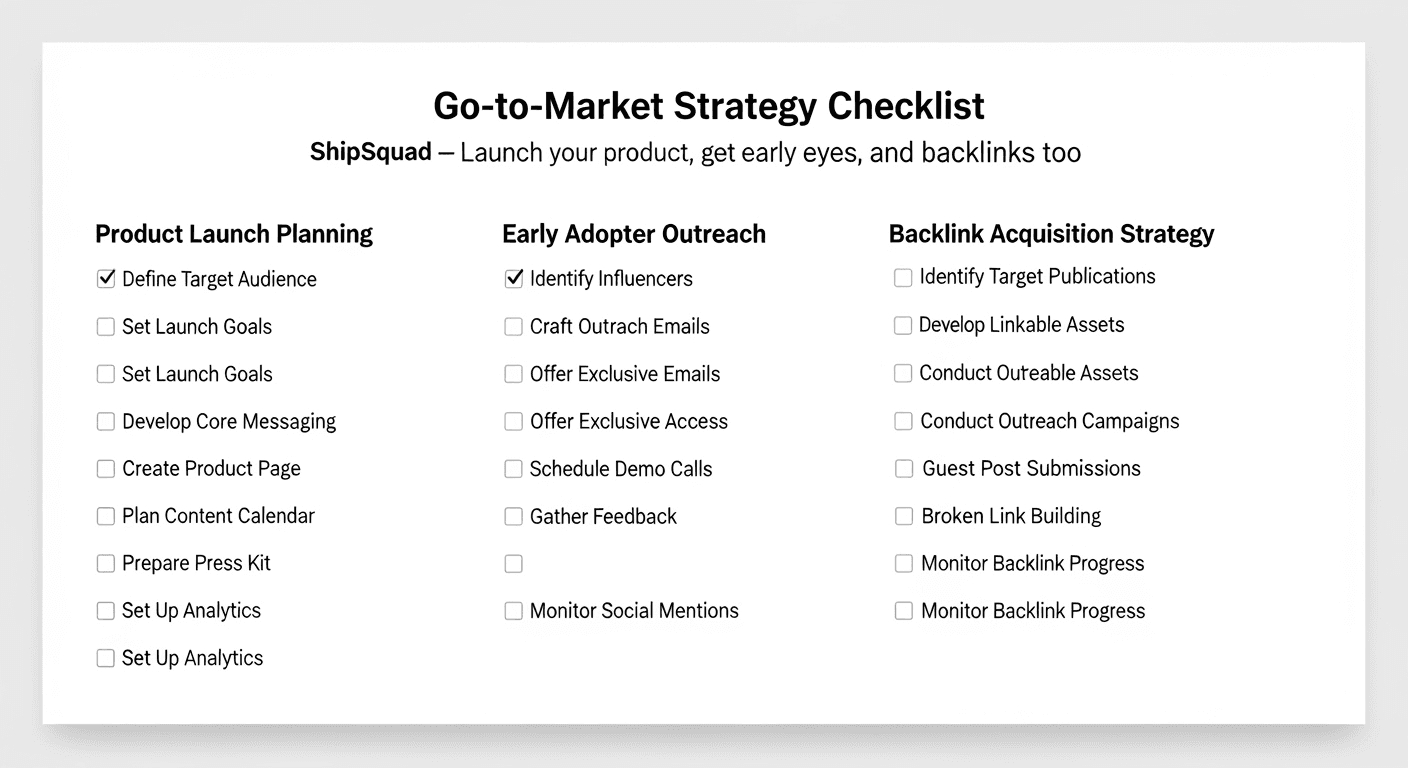
Phase 1 — Pre-launch: lay the foundation
Preparation > performance. Spend time here, and launch day becomes amplification, not scramble.
1. Define your target audience & ICP
- ☐ Write one short sentence: “We help [who] solve [specific problem] so they can [benefit].”
- ☐ List the top 3 pain points in the exact language your users use.
- ☐ Run 5–10 quick discovery interviews or a 1-minute survey to validate language.

- Why: If visitors don’t see themselves in your headline, they leave in 3 seconds.
2. Positioning & core messaging
- ☐ Create a one-line Unique Value Proposition (UVP) — avoid feature lists.
- ☐ Build 3 messaging pillars that support your UVP (benefit-focused).
- ☐ Draft a 30-second elevator pitch and test it on 3 people who match your ICP.
Output to publish: UVP + 3 bullets you can reuse across landing page, email, and product listing.
3. Competitive map (fast)
- ☐ List 3 direct competitors + 2 indirect solutions (spreadsheets, workarounds).
- ☐ One-line gap for each competitor: “They do X, but don’t solve Y.”
- ☐ Note one place where you can be clearly different (pricing, onboarding, niche).
4. Goals & math (yes, the math)
- ☐ Pick 1 north-star metric for launch week (e.g., signups, trials, demo requests).
- ☐ Choose 2 supporting KPIs (traffic source A, conversion %).
- ☐ Work backward: if you want 100 signups and conversion = 5%, you need 2,000 visitors.
Publish tip: Add a small table showing goal → conversion → traffic targets (helps readers copy your thinking).
Phase 2 - Launch: making a splash (without burning out)
1. Pick 1–2 laser-focused channels
Focus beats presence. Choose the channels where your ICP already spends time.
Channel checklist:
- ☐ Community (subreddit, Indie Hackers, specialized Slack) — best for feedback and early traction
- ☐ Discovery platforms (Product Hunt, BetaList, niche directories) — good for spikes and PR
- ☐ Owned channels (email list, blog, founders’ networks) — highest conversion
Decision rule: If you have <1,000 emails, prioritize community + one discovery platform; don’t try to be everywhere.
Here is a quick comparison table.
| Feature | Product Hunt | BetaList | ShipSquad (shipsquad.space) |
|---|---|---|---|
| Primary Goal | Generate launch day buzz and traffic. | Get sign-ups for a pre-launch product. | Get early users, genuine feedback, and high-quality backlinks. |
| Cost | Free to submit. | Paid options for faster review/more visibility. | Completely free, no paid tiers. |
| Audience | Broad tech enthusiasts, investors. | Early adopters, tech enthusiasts. | Indie makers, early adopters, and builders focused on sustainable growth. |
| SEO Benefit | Minimal long-term SEO impact. | Limited SEO impact. | A core feature. Provides valuable do-follow backlinks to boost your site's authority from day one. |
| Best For | Products with broad appeal and a polished finish. | Validating an idea before building. | Indie makers and first-time founders who need visibility, user validation, and foundational SEO without any cost. |
2. Launch assets to prepare (finish these before T-minus 0)
- ☐ High-convert landing page (single crystal clear CTA)
- ☐ Short demo video (60–90s) or 3 screenshots with captions
- ☐ Email sequence (teaser, launch, follow up, social proof)
- ☐ 1 pager for press/influencers with key bullets & screenshots
3. Launch day execution (hourly checklist)
- T-2 hours: final test of sign-up/payment flow (run a real transaction).
- T-1 hour: post to core community (contextual post, not spam).
- Launch hour: announce on owned channels + discovery platform.
- Launch + day: engage for first 8 hours — answer comments, iterate replies.
- Launch + 24–72 hours: push second wave (guest post, newsletter, partner shoutouts).
Note: Engaging early (first 2–6 hours) multiplies signals: people stay longer, comment more, and share.
Phase 3 - Post-launch: turn the spike into momentum
The launch isn't the finish line; it's the starting line. Many founders make the mistake of relaxing after launch day, but this is when the real work of building a sustainable product begins. This final section of the go to market strategy checklist is about turning that initial spark into a long-burning fire.
1. Feedback & iteration
- ☐ Capture feedback centrally (Notion/Google Sheet).
- ☐ Run short follow-ups: “Can I ask two clarifying questions about how you used X?”
- ☐ Prioritize one small UX fix that improves conversion and ship it in 7 days.
Evidence placeholder: insert a screenshot of your feedback dashboard or a before/after conversion graph.
2. Community & retention
- ☐ Create a small “home” (Discord, Slack, or forum).
- ☐ Invite the first 50 users personally — ask 3 questions and seed conversation.
- ☐ Reward early contributors publicly (badges, shoutouts, credits).
3. Content & SEO foundation
- ☐ Publish 3 how-to posts that solve the same problem your product fixes.
- ☐ Use one original micro-case (from your launch) inside those posts.
- ☐ Start a backlink campaign: reach out to 5 relevant blogs with a unique angle.
Pro tip: a single quality backlink from a niche site beats ten low-value links.
Common pitfalls — avoid these traps
- Spreading effort across too many channels. (Pick two and own them.)
- Waiting for feature-complete before asking for feedback. (Ship something small.)
- Treating launch as a campaign instead of the start of continuous growth. (Plan Day 2+.)
- Using generic CTAs and repeated boilerplate copy. (Write one sincere, specific CTA.)
Conclusion: Your Launch Is Only the First Chapter
A go-to-market strategy isn’t a one-day event — it’s a system. Launch day gives you visibility, but what you do before and after launch determines whether your product fades or compounds.
By following a structured GTM checklist, you turn guesswork into a repeatable process:
- You validate before building.
- You launch with clarity instead of noise.
- You collect feedback early, ship improvements fast, and build trust with the first users who bet on you.
Most importantly, you avoid the biggest startup killer — launching into silence.
If you want momentum that lasts beyond launch day, combine community-driven early users with channels that give you long-term discoverability. Even a single well-placed backlink or small group of engaged power users can anchor your product’s growth for months.
Your product deserves a launch that actually reaches the people it was built for — and a plan that helps it grow long after day one.
Recommended Videos
- How to Create a Go-To-Market Strategy | GTM Strategy Explained
- The Perfect Go-To-Market Strategy for a New Product
Frequently Asked Questions (FAQs)
1. What is a go-to-market (GTM) strategy?
A GTM strategy is a step-by-step plan for introducing your product to the right audience using the right messaging and channels. It helps ensure your launch attracts real users instead of disappearing into the noise.
2. Why do I need a GTM checklist?
A checklist makes the launch predictable. It prevents you from missing critical steps like validation, community prep, and post-launch follow-up — the things that often decide whether a product gains traction or goes unnoticed.
3. How long should I spend on pre-launch?
For most indie makers, 4–8 weeks is enough to validate the problem, refine your messaging, build a small waitlist, and prepare launch assets without losing momentum.
4. Can I launch without a marketing budget?
Absolutely. Many successful early products launch with $0 using communities, content posts, early adopter platforms, and direct outreach. Budget isn’t the barrier — clarity and consistency are.
5. What should I focus on after launch day?
The first 30 days are crucial. Prioritize gathering feedback, improving onboarding, fixing friction points, and communicating updates. This turns early users into long-term advocates.